Clean Cooking: It's Not About Your Ingredients. It's About How You Work.
If you searched "clean cooking" expecting another article about organic, gluten-free, dairy-free, sugar-free, fill-in-the-blank-free eating, this is not that.
When I say clean cooking, I am talking about something else entirely. The work behind the plate. The discipline of how a kitchen runs. The difference between a cook who knows where every minute and every ingredient is going, and one who is improvising in the dark and hoping it works out.
Clean cooking is a craft philosophy. It has almost nothing to do with what you buy and almost everything to do with how you work.
What I Actually Mean by Clean Cooking
After more than 30 years of professional cooking, here is the simplest way I can say it.
In the kitchen, everything has a purpose and timing.
That is the whole thing. Every step you take, every cut you make, every minute you spend is either moving the dish forward or it is not. Clean cooking is the discipline of knowing the difference.
It is about technique. It is about intention. It is about making a thousand small decisions in a row, each one adding up to a finished plate that actually tastes like something.
The ingredients can be cheap. The kitchen can be small. The clock can be tight. None of that gets in the way of clean cooking. What gets in the way is treating all shortcuts as if they are the same.
The Two Kinds of Shortcuts
Every kitchen, professional or home, runs on shortcuts. There is no way around it. We are all working against time.
But there are two very different kinds.
Real shortcuts make the work flow. They protect the dish, save effort, and compound over time. The more consistently you use them, the more natural they become, and the less you have to think about them.
Lazy shortcuts quietly cut into flavor, texture, and finish. They feel like time saved in the moment, but they steal from the plate. The cost is not always obvious right away, which is what makes them easy to keep making.
Knowing which is which is half of clean cooking.
Real Shortcuts: The Ones That Buy You Flow
Real shortcuts are about organization, sequence, and using your downtime well. Here are the ones I rely on every time I cook.
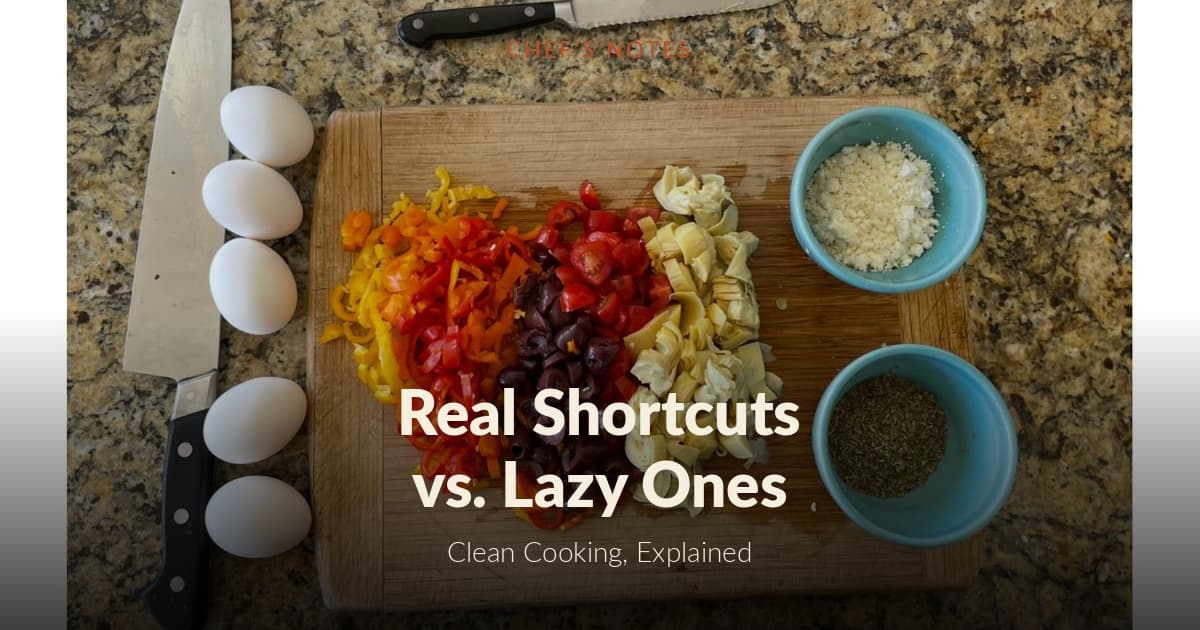
Mise en place. Read the recipe through before you start. Prep everything you need. Group your ingredients by when they hit the pan. When the burner turns on, you are not scrambling for a spoon or realizing the garlic is still unpeeled. The dish is half finished before it starts. This is the single highest-return habit in any kitchen.
Cleaning during the lulls. Every cook has a window while the onions sweat, the rice steams, or the oven does its work. That is not a break. That is when the cutting board gets washed, the prep bowls go in the sink, and the countertop gets cleared. You finish cooking in a clean kitchen instead of facing the mess after the meal. The difference in how you feel at the end of the night is significant.
Grouping by technique. Anything that gets diced, dice it all at once. Anything that gets minced, mince it all at once. Switch knife technique only when you have to. You move faster, your cuts are more consistent, and your mise en place comes together cleanly.
Salting early. Salt needs time to actually penetrate. Seasoning at the end is salting a wall. Season your proteins before they go in the pan. Let your vegetables get a pinch before they roast. Taste and adjust at the end, but give the salt a head start.
Making extra when the kitchen is already hot. If the pan is on, the oven is up, and the prep is done, the marginal cost of doubling the recipe is close to zero. Tomorrow's dinner is already half cooked. The effort is in getting the kitchen running. Once it is running, you might as well use it.
I will go deeper on each of these in a follow-up post. For now, the principle: real shortcuts buy you flow without costing the plate anything.
Lazy Shortcuts: The Ones That Quietly Cost You
These are the habits I see most often and the ones I trained myself out of over years of cooking professionally.
Leaving the green sprout in garlic. As a clove of garlic ages, a green germ grows inside it. That sprout carries a sharper, more bitter flavor, especially noticeable in raw or lightly cooked dishes. Removing it takes five seconds. In a vinaigrette, a pesto, or a garlic butter where garlic is the lead, the difference is real and immediate. If you want to go deeper on garlic, I wrote a full post on it: From Bitter to Beautiful: A Chef's Guide to Cooking Garlic.
Ignoring the tender herb stems. The thick, woody stems stay out. But the tender parts of cilantro and parsley carry as much flavor as the leaves. Separate them from the bigger stems, dice them small the way you would chives, and put them to work. The same logic applies to the white bottoms of scallions and the tender inner parts of leek tops. Throwing those away is throwing away flavor.
Leaving the seeds in a tomato when they matter. In a long-simmered sauce, the seeds mostly disappear. But in a fresh dish where the tomato is the lead, a raw salsa or a bright summer plate, the seeds water everything down and dilute the flavor. Scoop them out. It takes ten seconds and the texture of the finished dish is completely different.
Not patting protein dry before it hits the pan. Surface moisture turns to steam when it hits hot oil. Steam prevents browning. Without browning, you lose the fond, you lose the crust, and you lose the layer of flavor that comes from the Maillard reaction. Pat the protein dry. You will hear the difference the moment it hits the pan. A confident sear instead of a wet hiss.
Crowding the pan. Same problem as moisture. Too many pieces of food in a hot pan drop the temperature and trap steam. Instead of browning, everything softens and stews in its own liquid. Cook in batches if you have to. The extra five minutes are worth it every time.
Skipping the deglaze. That browned, stuck-on layer at the bottom of the pan after you sear a protein or caramelize an onion is concentrated flavor. A splash of wine, stock, or water loosens it and pulls it back into the dish. That is your sauce. Skipping it means washing flavor down the drain.
The pattern is the same in every example. A small step gets skipped. The dish loses something specific. The cook either notices and adjusts, or never quite figures out why the food never tastes the way they wanted it to.
Everything Has a Purpose and Timing
When I cook a dish, my goal is for every bite to taste exactly the way I meant it to. That does not happen by accident. It does not happen by working faster. It happens because every step had a reason and every minute was used.
That is why I keep coming back to the same line: in the kitchen, everything has a purpose and timing.
Clean cooking is the framework that makes that real. It is not about being a perfectionist. It is about being intentional. It is the quiet difference between food that tastes good and food that tastes like you meant it.
Where This Connects to the Protein Flip™
The Protein Flip™ approach is built on the idea that you can build a satisfying, complete meal with less animal protein and more plants: legumes, grains, and vegetables doing more of the work on the plate.
That only holds up if the technique is solid.
When you reduce the richness that comes from larger portions of meat, you have to build flavor through layering, seasoning, and execution. The real shortcuts give you the structure to do that efficiently. The lazy shortcuts are where flavor quietly leaks out. Getting your garlic right, building your base well, using your technique intentionally. That is how a plant-forward plate still tastes like it was made with care.
Clean cooking is not a separate thing from the Protein Flip™. It is how the Protein Flip™ actually works on the stove.
Try This Tonight
Pick the next dish you cook. Before you start, ask yourself two questions.
What is one real shortcut I can use to make tonight flow better? Maybe it is mise en place. Maybe it is cleaning during the lulls. Maybe it is salting earlier than you usually do.
What is one lazy shortcut I am about to take that I should stop taking? Maybe it is the garlic sprout. Maybe it is the wet protein. Maybe it is the crowded pan.
Stack a few of those wins and the food starts to taste different. Not because the ingredients changed. Because the work did.
Balanced Protein. Better Living. Healthier Planet.
Keep reading