Change What You Can: How I Kept My Culture and Still Flipped My Plate
There's no doubt that genetics play a role in our health. Some of us are predisposed to certain conditions. Our bodies respond to food, to movement, to stress in different ways. None of that is a choice.
But here's what I've learned, both personally and professionally.
We may not control our genetics. But we can absolutely influence the way we live.
Abuela's Kitchen
I grew up Hispanic, and the food of my childhood wasn't just food. It was love on a plate.
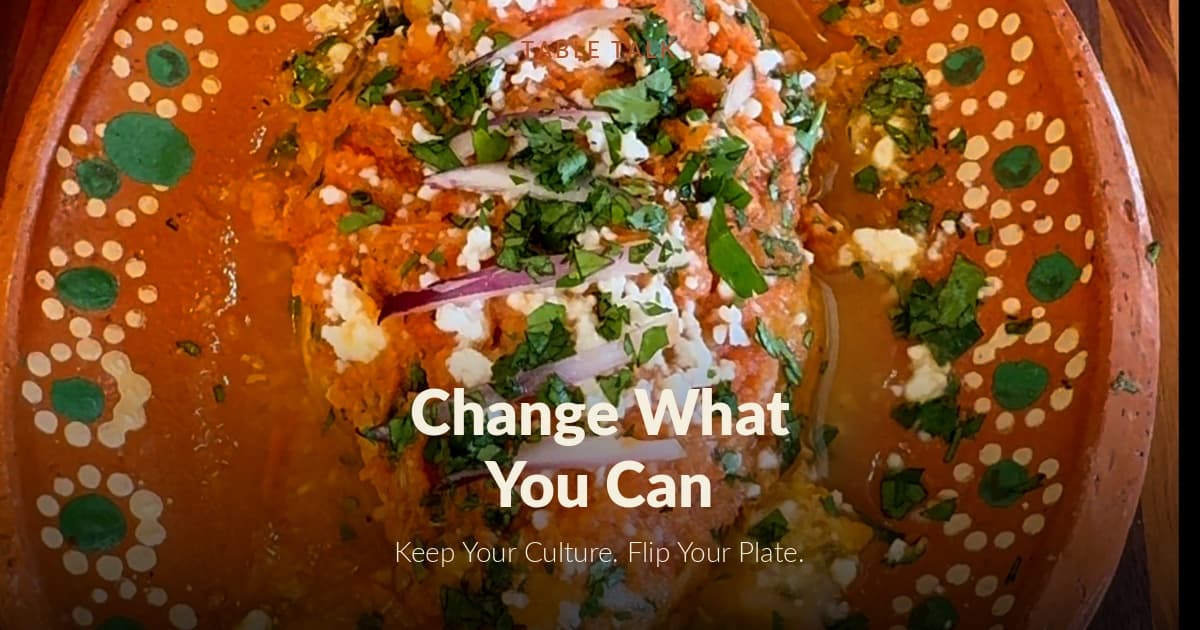
Hand-rolled flour tortillas, made fresh on the comal. Mexican rice on a Sunday afternoon. Tamales steaming through Christmas Eve. Enchiladas at a family gathering. Pan dulce in the morning, sweet and warm and gone too fast. These weren't just meals. They were how we said we're together without having to say it. Every celebration. Every ordinary Sunday.
And the center of the kitchen, always, was Abuela.
She didn't teach with recipes. She taught by example. Watch what I do. Then do it. Sometimes she'd explain. Sometimes she wouldn't. The lesson lived in the rhythm of her hands and the sound of the kitchen, and you absorbed it whether you knew you were absorbing it or not.
That's how I learned to cook. And years later, when my daughter was old enough to stand on a stool next to me at the counter, that's how I taught her. The line from Abuela's kitchen to my kitchen to my daughter's kitchen is one continuous line. The dishes changed. The method changed. The way of teaching, watch and then do, did not.
I carried Abuela's kitchen into a 30-plus year career as a chef. Catering. Private parties. Cooking classes. Every dinner I ever cooked, every class I ever taught, had her imprint somewhere in it.
The Question That Changed Everything
Years later, when I started my own health journey, I started asking a different question.
What if I could keep the soul of these dishes and still make choices that better supported my health?
The answer wasn't to abandon the food I grew up with. The answer was to transform it.
I started experimenting in my own kitchen. Swapping lard for heart-healthy oils. Letting vegetables share the plate instead of sitting on the side. Finding ways to boost protein and fiber without losing the flavor that made the dish what it was. The result was familiar but lighter. Still rich. Still mine. Still the food of Abuela's kitchen, just built for the body I'm in now.
Through that work, I discovered something that has shaped every recipe I've written since.
Change doesn't have to be all or nothing. It just has to be intentional.
Three Lines That Still Run My Kitchen
The longer I worked on this, the more it came down to three lines.
Change what you can. The lard. The portion size. The cooking method. The balance of protein to plant. These are choices, not commandments. You're allowed to make them differently than the people who taught you, without disrespecting the people who taught you.
Keep what feeds your soul. The dish itself. The reason it's on the table. The Sunday rhythm. The smell that brings someone home. Don't trade your culture for a trend. Trade only what isn't serving you anymore.
Never underestimate the power of a small shift made with love. This is the piece most people miss. The small swap, made consistently, with intention, beats the dramatic gesture every time. One ingredient. One method. One meal at a time.
That's the foundation underneath the Protein Flip™ method. The method didn't come from a lab. It came from a chef trying to keep his abuela's table on his plate while actually listening to what his body was telling him.
What This Doesn't Mean
It would be easy to read all this as "give up your culture" or "eat sad food in the name of health." That's not what I'm saying. It's the opposite.
The food I cook today is more flavorful, more balanced, and more mine than the food I cooked at twenty-five, when I was just executing what I'd been taught. Honoring a tradition isn't repeating it without thinking. Honoring a tradition is keeping it alive in the body of the person you've become.
My goal has never been to erase my culture or my history. It's to honor it while building a healthier future, for myself and for the people I cook for.
If You're On Your Own Version of This
If you're navigating your own path to better health, especially in the face of cultural habits or family history, I'll leave you with the same three lines.
Change what you can.
Keep what feeds your soul.
And never underestimate the power of a small shift made with love.
The plate doesn't have to look the way it always has. But it should still feel like home.
Balanced Protein. Better Living. Healthier Planet.
Keep reading