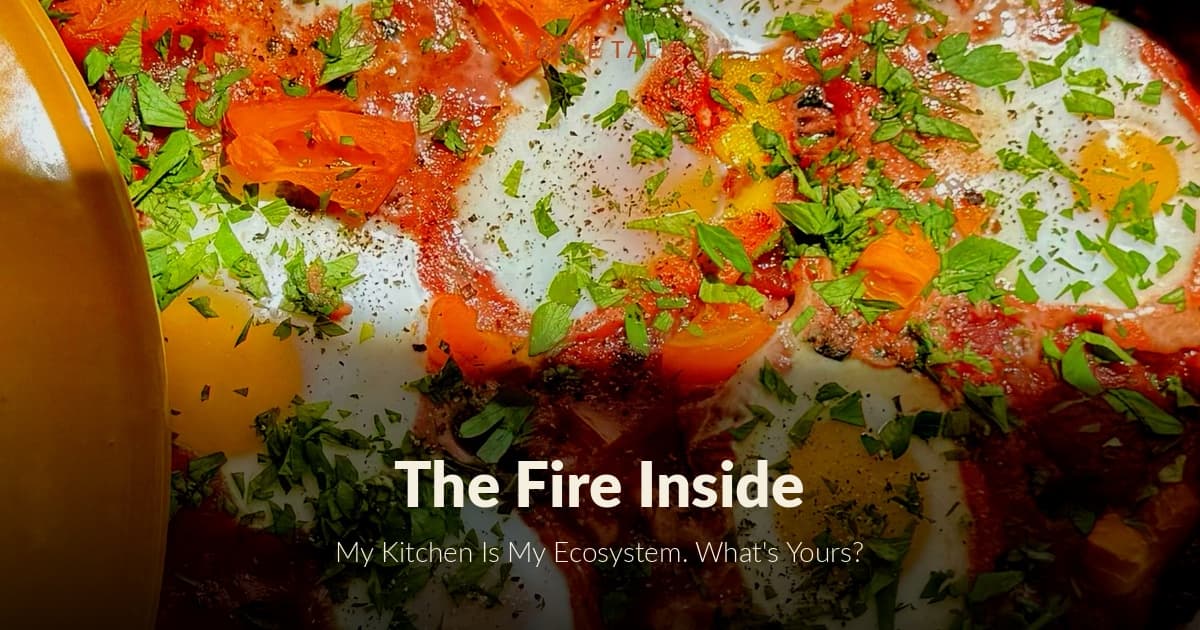
The Fire Inside: My Kitchen Is My Ecosystem. What's Yours?
Some days the fire is loud. The work is going right, the timing clicks, the food comes together, and you can taste the next move before you make it.
Other days the fire is barely a flicker. You burn the sauce. You drop the timing. You finish a long night with nothing to show for it but a counter that needs wiping and a sink full of pans, and you wonder, briefly, why you keep doing this.
You keep doing it because the fire is yours. And the place where the fire lives is yours, too.
That second part is what most people miss.
What I Mean by Ecosystem
There's a fire inside each of us. People say it all the time. What people say less often is that the fire needs an ecosystem.
By ecosystem, I mean the actual place, the actual practice, the actual domain where your fire gets fed. It's where you go in. It's where you fail. It's where you start over. It's where the small acts add up over years until one day you look back and realize they built you.
Mine is the kitchen.
Cooking is where the small things compound. A cleaner cut. A quieter pan. A sauce I didn't oversalt. A piece of fish I didn't overcook. A plate I brought to the table that tasted exactly the way I meant it to. Each one of those is a small act that nobody else clocked, except me. And those small acts, stacked across thirty years, are what made me a chef. Not the press. Not any one big night. The fish. The sauce. The plate. The thirty years of them.
That's an ecosystem. The fire is the energy. The kitchen is where the energy gets to be something.
The Disappointments Are Part of It
I've burned a lot of sauces. I've ruined a lot of sears. I've missed garnishes. I've had nights where the whole rhythm fell apart and there was nothing to do but turn the music off and clean.
Disappointment isn't the opposite of the fire. It's part of how the fire stays honest.
The night you fail at something is the night you actually understand what that something is. The next time you make that sauce, you make it knowing what wrong tastes like. That knowledge becomes fuel. The fire doesn't mind that the lesson hurt.
This is true outside the kitchen, too. The thing you keep at, the thing you keep coming back to even after a bad night, is your ecosystem. The fact that you're still showing up is the fact that the fire is still yours.
Cleanup Is Part of the Cooking
People think cleanup is the chore at the end. The price you pay for the meal. The thing you power through so you can finally sit down.
For me, cleanup is part of the meal.
I do my best thinking with a sink full of warm water and a stack of pans in front of me. The cooking is over. The table is clear. The guests have gone home, or they're settled in the next room. And in the quiet of that, I get to walk back through what just happened.
What worked. What didn't. The bite where the seasoning landed exactly right. The corner of the plate that needed something it didn't get. The dish that brought the room together. The one that didn't quite. By the time the last pan is dry, I know what I'm doing differently next time.
That's not the chore at the end. That's the reflection that makes the next dinner better than the last one. The fire isn't done burning when the cooking stops. It's still burning at the sink.
The Little Things Are the Whole Thing
People want a moment. The breakthrough. The hero shot. The dish that goes viral, the deal that closes, the medal at the end.
But the little things are the whole thing.
The fire is fed in tiny consistent acts that nobody puts on a reel. Reading the recipe before you start. Cleaning during the lulls. Salting the right amount. Choosing not to crowd the pan even when you're rushing. Calling the parent. Sitting back down to the page. Putting on the running shoes. Returning to the canvas. Showing up at the keyboard. Picking up the instrument again.
These are not the things that go on the wall. They're the things that build the person who, one day, has something to put on the wall. The fire isn't fed by the framed photo. It's fed by the ten thousand minutes nobody saw.
What's Your Ecosystem?
Mine is the kitchen, and I'm lucky to know it. A lot of people aren't sure what theirs is yet.
For one person, it might be a workshop. For another, a garden. A piano. A keyboard. A trail. A garage. A canvas. A child's bedside. A patient's chart. A classroom. A page in a notebook nobody else will ever read.
The work is to find yours. And then to feed it. Daily, if you can. Imperfectly, if you have to.
The fire will tell you you're in the right ecosystem when you keep coming back even on the bad days. That's the signal. Not the wins.
If you don't know yours yet, that's fine. You're allowed to wander a little. But pay attention to where you keep landing. Pay attention to where the disappointments don't drive you out. Pay attention to where the small acts feel like they matter, even when nobody is watching.
That's the ecosystem. That's where the fire lives. Tending it is how you become the person you're supposed to become.
Inner Peace Is Domestic
The deepest peace I know comes from knowing where my fire lives.
It's not abstract. It's not in a retreat. It's not a hashtag. It's domestic. It's daily. It's in the rhythm of a kitchen I know how to walk through with my eyes closed, all the way through to the last clean pan in the rack.
Find yours. Feed it. The fire inside isn't a metaphor you read about. It's a thing you tend, on the days that go beautifully and the days that go to hell, until one day you realize the tending was the becoming.
So if you're in the middle of the climb, keep going. If you're standing on a peak looking back, take a moment to honor the small steps that got you there. The fire is the same on either side. It just needs an ecosystem to live in.
Mine is this kitchen.
What's yours?
Balanced Protein. Better Living. Healthier Planet.
Keep reading